Showing posts with label first nations. Show all posts

Thursday, September 8, 2011

"Don't be a tool" - or - Dialogue about racial equity in Alaska


A few weeks ago, I was waiting in my car for my sister to come out of a grocery store, window down, and two young men, both white, were having a loud discussion about race. I tried (not very hard) to not listen, but as I was in the middle of the unnerving project I’ll describe in a bit, bad manners took over. They discussed different racial problems, whether minorities should be “blaming” everything on race, whether affirmative action was right, and one was vehement that the “Native Pride” hats were racist in nature. What struck me was – they probably would be talking a bit differently if I was part of the discussion. Or even if they knew I was listening.

I don’t mean to say they were racist for discussing this, or that they would for sure even curb away from what they were saying. But the nature of racial dialogue in Anchorage is such that with the entrance of a (somewhat opinionated) Native woman into the conversation, I’m pretty sure there would be either a) holding back from all true opinions out of not wanting to stir something up that can’t be taken back, or b) a blood bath.

Okay, I’m SURE we could remain civil. But experience tells me when people of different races radically disagree about race relations in Anchorage, the conversations don’t generally go all rainbows and bunnies.

I began this blog over three years ago, and one of my first posts was about an incident that happened downtown. A group of us, all Native, were downtown for an event, and were suddenly, and without provocation, verbally abused by a loud, angry man. The comments were ugly, and racist. But my concern was not as much the man, but the reaction of our group:

(We were) A group of young, professional Native people, mostly women, who have every right to be proud of themselves and their accomplishments. Our reaction? We lowered our heads, we didn't meet each other in the eye, we dare not look at another person in the crowd, for the shame of it… We didn't yell back, we didn't argue, we didn't console or comfort each other, we didn't talk about.


Aside from the fact that I just annoyingly quoted myself, in three years, I realize I still haven’t answered for myself the questions I was pondering in the post. Why was this our reaction? What can be done?

But a recent experience has made me look at this in a new way. I was invited to participate in a project hosted by First Alaskans – a project to start a dialogue about racial equity. To start many dialogues, actually, in many different communities around Alaska. I went in to be trained as a host of some of these dialogues, with a large group of supporters.

Here’s where my heart rate starts to rise.

It wasn’t actually the group itself that made me nervous. I think partly from posting here over the years, and partly because I just talk about race a lot with friends as I try to answer my own question, I was pretty comfortable the first day we got together. It was a day to share our own stories, our own ideas about race in Alaska.

 As we went around the large circle for several hours, each person taking a turn, it was at times heartbreaking, at times infuriating, at times inspiring. There were many occasions I could relate to the speaker, and many more that sparked ever more questions.

It was the two days after the initial meeting where I started to wonder what I’d gotten myself into.

In a much smaller group, it started getting a little more real about us hosting these discussions, and here’s where I start to have imaginary dialogues, hosted by me, in which I get run out of town or alternately start a proverbial fire in a community that leads to paintballing and race riots (it’s part of my process.)

While we were being trained, I discovered several people had similar fears.

“How do I walk by these people in the store if this goes wrong?”

“My community is not going to like this kind of talk.”

Yet, we’ve seen that positive outcomes CAN come from racial dialogue. A year ago to the week, I posted about First Alaskans’ effort in a pretty public racial dialogue. Julie O’Malley said it best, but in short, there was some ugly racial comments said about Native women over three years ago by two local radio DJs. The reaction was swift, angry, accusatory, and I don’t know that anyone was happy with the outcome.
But an effort when different racial comments were made by different local DJs was... well, markedly different. Instead of anger, education. Instead of calls to pull ads, a call to talk. The outcome? Much, much better for everyone.
Said O'Malley, "And I left the press conference wishing that more conversations about race in Anchorage could end that way. Because we’d all be better for it."

So, my neurosis about being run out of town pitchfork-style aside, after meeting these empowering, strong, open people, after some truly thought-provoking dialogue led by First Alaskans, after voicing my own fears and hopes (and more fears,) I can’t answer a single question I posed over three years ago with any authority. But I have a little more hope that, with talking, with compassion, with incredible patience, we can turn the direction of racial equity in the state.

Though the two gentlemen outside the grocery store already had it said pretty succinctly:

“But don’t you think some people just really hate people from different races?”

“Yeah… if you’re a total tool.”

He probably won’t be hosting a dialogue, but I really want to hear more of what he has to say.

Sunday, July 17, 2011

Does keeping Native languages alive even matter? Part 2

I posted the other day about Native languages and the ongoing conversation I hear about whether it is even of any value to do so. With as many "reasons" as others come up with on how it is not any value, I've split up my own discussion into several parts:

"We're all going to one language anyways"

Whether that is true or not (and it's certainly not happening in anyone's lifetime alive now,) the value of having these languages not only not go extinct, but thrive, is sadly losing potency as the years wear on. This is, quite simply, because each year we're losing more and more people who know what is behind the language.

There are many, many words and phrases in any language that are not simply a way to say the same thing in any language. There are ideas, thoughts, values, philosophies - whole religions - that you can only talk about comprehensively in a certain language. My mom talks about my grandpa (whose first language was English, I might add) who would struggle to impart a Tlingit philosophy or value he learned growing up, but would throw up his hands with a, "There's no way to say that in English!"

A Tlingit teacher I had talked about one word - just ONE word - in Tlingit, "Eetoowoo" (and yikes, I think I just hacked up that spelling!) It is translated in English as "sorrow." But I can still hear her voice as she tried to explain what it really meant - it was more than sorrow. It was a deep, deep sadness that the whole body, the whole being, was involved in. Not a word, or even meaning, we have in the English language. I still don't know what she meant.

I've heard people say they can experience a culture by visiting it, by attending a dance, by reading about it - therefore why not just all speak the same language as the language isn't a part of it?

But culture isn't about attending a play or viewing a piece of art. It literally makes up who a person is.

If you think language isn't important to a culture, I challenge you to learn another language fluently. Use this language, and only this language, to your children, and forbid them to speak English. Then tell me the stories your father told have the same weight. Tell me the songs your mother sang to you can be passed on. Tell me the jokes you've giggled at since you were in high school translate to this language, and your favorite books make as much sense. I gaurantee you MUCH will be lost. Even if you're able to capture big chunks of it, there's no way to translate a whole culture into a different language in one generation.

Now try and think of this as a large group of people trying to do the same thing. Values, stories, philosophies, songs - we've already lost so much. But if we can literally speak the same language as those who can still teach it before it's too late, it won't all be gone.

Thursday, January 20, 2011

Tuesday, January 18, 2011

Native issues in perspective

A little collection of opinion on Native subjects, and Native opinions on "everybody" subjects.

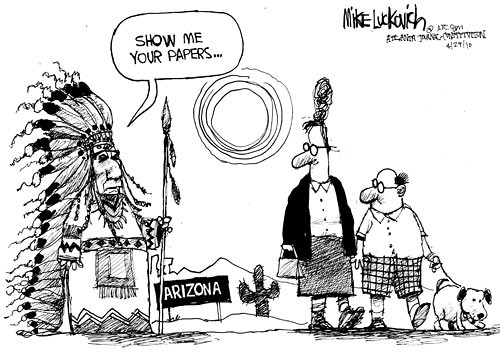
native-american-indian-immigration-political-cartoon


So, the first one isn't new, but I just found it, so it's new to me! I've seen different versions of this "Native American and immigration" joke, but it pretty much sums up how I feel about immigration today - and why I don't think many Native people (at least not up here) feel very strongly against "modern-day" immigration. Kinda too late now!


Are we a nation doomed to be violent?
An excellent piece in Indian Country Today by Mark Trahant, regarding the Arizona shooting:
"Let’s use this tragedy as the call to civility. When political rhetoric goes too far, say so. Seek out those disagree and praise them for their ideas, then politely dissent. We must praise those who agree to disagree. We need to make the politics of hate absolutely unacceptable."

Sanitizing Mark Twain classics
I've seen this in the news for a while now, and have tried not to roll my eyes every time. For those that haven't seen it, there's a new edition of Huckleberry Finn and Tom Sawyer that eliminate the usage of words like "injn" and the big N. A bias, maybe - big Twain fan - but I came across this (long!) American Indian analysis focused more on taking out the "injun" references, and got pretty engrossed. While the huge post is great as a critical review and summary of the passages that include the word, I thought the comments below it were very well thought out as well. A few excerpts:

"Taking out the stinging words, sugar-coats and white-washes some of the nasty bits of American history. It pretends those words were not used and some ancestors were better human beings than they really were.

Who exactly is the sanitized edition for? Obviously, not for American Indians and African-Americans."

"Just as my dad was a product of his times, that's the way I think we should read Tom Sawyer & Huck Finn--as products of their time, with language of the time."

Sanitizing the MLK message
This is from an interesting blog I follow, Newspaper Rock ("Where Native America meets pop culture"). Although I don't fully agree with this opinion (that might be a reprint itself?) that we (and specifically Michelle Obama) shouldn't be so "service oriented" on this day, it made me think pretty differently about it. Worth a read!

Monday, January 17, 2011

Alaska Native news roundup

A few topics/stories I've seen making the online rounds:

A Yup'ik Swan Lake
Too cool! The Alaska Dance Theatre, Alaska Dance Theatre School, Alaska Native Heritage Center and Eugene Ballet Company are collaborating on a revision of the classic Swan Lake ballet with Yup'ik storytelling and dance. I used to be skeptical of these kind of attempts, but several years ago I went to the Anchorage Symphony's collaboration with Native hoop dancing and flute music - AWESOME PERFORMANCE. I'm ready to see more mixin'! I hope it runs longer than this week!

Native corporations sue over polar bear decisions
This is being reported many places, and I'd love to see some polling of the region. For Pebble Mine, for instance, BIG difference between whether the people of the region support it, and the corporations of the region support it. I don't have a very informed opinion of this, outside of the documentaries and talking heads, but I certainly lean toward long-term wildlife preservation over immediate wants of commerce.

Lots of talk about Alaska Native suicide numbers
So, it seems like nothing new - the Alaska Native suicide rates are still horrible. I've even heard people talk about not bothering putting any more resources into stopping suicide if it doesn't seem to change the numbers. ADN has reported on it in multiple ways, the most recent a little revisit of their "People in Peril" series from 20 years ago. KTUU has done a few segments in just a few days, Alaska Newspapers, and many, many more, mostly due to the state's annual report that recently came out.

But let's not stop trying. IIt may seem like "the same thing over and over again" over the past 20 years." But over the past few years, I've been looking at research and case studies in suicide, especially suicide in indgenous populations. Here's the news I hope people also pay attention to:

1) The "science" of trying prevent suicide at a mass level is very, very new. Or rather, the only way it was done before not very long ago was through religious belief (suicide as a sin, etc.) The "answer" was never going to be simple, quick, or gauranteed the first, second, or hundredth round out. Twenty years may seem like a long time to be trying, but in the life of a disease, is but half a moment.

2) Is there a cure for cancer yet? I don't see anyone saying, after all this time, and all this money spent without a cure, MUCH longer, and many more billions spent than suicide prevention, that we should give up on our attempts at preventing cancer.

3) Suicide is not as simple as people would like to think. It is hugely misunderstood, and it is truly a disease, as are the many underlying factors leading up to it.

Tuesday, February 16, 2010

Elizabeth Peratrovich Day

So I come out of my frazzled and frustrated writing haze to... well, write. But had to give a little tip of the hat to Elizabeth Peratrovich on Elizabeth Peratrovich Day - or the 65th anniversary of the passing of the Alaskan Anti-Discrimination Bill.

For the most part, I'm just going to repost last year's bit, "What is Elizabeth Peratrovich Day?" I do want to add one GREAT way to celebrate the day (or just get a little culture) is to watch "For the Rights of All" - starring Diane Benson. It tells the story much better than I can!


Far too many Alaskans still don't know what is celebrated on this day, so read up and pass it on!


After a long session of lawmakers debating civil rights in Alaska, one senator posed the question:


"Who are these people, barely out of savagery, who want to associate with us whites with 5,000 years of recorded civilization behind us?"


A poised and eloquent Tlingit woman answered him:


"I would not have expected that I, who am barely out of savagery, would have to remind gentlemen with five thousand years of recorded civilization behind them of our Bill of Rights."


Elizabeth Peratrovich, and her husband Roy, were tireless workers in the fight for civil rights in Alaska. They were also pretty darn successful. In part because of this statement, and the rest of Elizabeth Peratrovich's speech, the anti-discrimination law got passed.


The uber-short version from yesterday's Juneau Empire:


It was in 1988 that the Legislature designated Feb. 16 - the anniversary of the signing of Alaska's Anti-Discrimination Act of 1945 - as a holiday honoring Peratrovich. She was instrumental in securing passage of the bill that outlawed racial discrimination in Alaska. The Alaska Act pre-dated passage of the federal Civil Rights Act of 1964 by 19 years.


The first time the speech of hers really hit home was a few years ago at the Alaska Native Heritage Center's celebration of the day. Diane Benson did sort of a one-woman performance of the speech, and some "thoughts" of Elizabeth, that was very moving.


At the celebration the Heritage Center was having this year (Saturday,) one of the Heritage Center workers, Loren Anderson, had some pretty inspiring (yet low-key) things to say about the our continued journey:


"Is prejudice gone in Alaska? We know that's not true..."


"Will you take some lumps for speaking up? Sure. But if you see that leadership opportunity, take it."


Today, I had a meeting regarding reconciliation and Alaska Native/non-Natives in Alaska. I couldn't think of a more fitting day to meet, or to begin this new venture. I'm excited!


A few more bits on Elizabeth Peratrovich:


A speech of Fran Ulmer (then Lt. Gov., now U of A chancellor) about Elizabeth Peratrovich.


From the Alaska Native Sisterhood's page on the day.

Wednesday, October 21, 2009

Pelosi promises on Native health care

From Indian Country Today:

“[W]e cannot ask Indian people to be penalized for choosing to use the Indian health care system,” Pelosi wrote.
“The House bill will ensure that the exemption from the financial penalties is extended to members of federally recognized Indian tribes, and that the tribally provided health care benefits are appropriately protected.”

Many lawmakers, both Republicans and Democrats, agree that American Indians have already paid for the cost of their health care many times over due to wrongful loss of lands, broken treaties, bad federal policy and other historical injustices imposed on tribal nations.

It's interesting to hear the "health care" buzz words going on at AFN/Youth and Elders conference downtown lately. The Alaska Federation of Natives convention is the largest gathering of Native people in the state, and there is always lots of politics going on.

Energy and economy, of course, are major topics, but in casual conversation alone, I heard so many Alaska Native people talking about health care.Technically, the convention hasn't started yet (tomorrow it kicks off) but the traditional Youth and Elders conference was packed with people talking about health care and what's going to happen. This from a people who, by majority, receive a differentform of health care than the average American.

At the very least, the focus on health care reform has created a genuine dialogue about health care where there was not one before. I can only think that's a good thing.

Monday, September 28, 2009

All men (and women) created equal - and able to equally become stupid criminals

I read Julie O'Malley's column (in the Anchorage Daily News) on the Masek sentencing last week, and it's been a point of discussion with several friends. Beverly Masek was an Alaskan representative convicted on corruption charges in the string of corruption investigations, indictments and convictions to hit the state in recent years, the most notable of them being Sen. Ted Stevens. Besides ol' Uncle Ted, I haven't commented on many of them, but Masek's I have, and she still continues to irk me.

Masek is Native, but that part isn't what bothers me either. Okay, that part does too, but not primarily. What bothers me is Masek seems to be so willing to play up the poor Native villager victimhood, instead of truly owning up, and genuinly making a stab at bettering herself. Or as O'Malley put it, "The defense was reaching for heart-strings, playing a cloying victim tune. But it relied on a musty stereotype about Native women I don't buy."

I know many Native women from rural Alaska. Despite whatever past so many of them had, despite what challenges they faced coming to the city, the ones I admire most are the ones who played on the strength of their ties to the village, not excused their behavior with it. They are the ones who took their past and heritage in hand and learned from it, leaned on it, were proud of it - and, actions big or small, could be proud of their present, too.

And let's not forget Ms. Masek signed up for the job. It's hard to sell the victim part when you literally campaigned to get the gig.

The offensive part isn't that she's Native and committed a crime (poorly done crime at that.) If anything, it shows how equally stupid people can be, no matter their heritage. What's offensive is that Masek and these lawyers are leaning on the "weakness" of her rural ties to prove she deserves to be pitied, not punished.

If Masek really believes her ties to rural Alaska created a weakness in her character, and that what she learned and experienced there were the cause of her criminality, I think she does deserve to be pitied. But she's also a criminal, and until she can show a willingness to change, the only thing left to do is punish so her bad example can at least be made an example of what not to do.

Thursday, September 24, 2009

Clarification from Obama administration for health care reform and Native population

From Indian Country Today:

Obama administration makes new promise on Indian health

I've been cautious to say anything on health care. As an Alaska Native, I've lived with pre-paid health care my whole life. It wasn't until I was a nanny, and had to navigate quite a bit of Denali Kid Care and doctor's outside of the Native health care system did I start to gain an appreciation for the enormity of the nation's health care problems.

I'm glad to see the Obama administration adjusting the plan to take in Indian health care, and he's already increased Indian health funding by more than has been in years. I'd like to see more details of what the differences are, what health care reform for Native people will look like, what it will look like for Indian Health Services.

A welcome quote from Murkowski in the article:

Later, when discussing the Indian Health Care Improvement Act, Murkowski acknowledged tribes have been waiting and working for 20 years to have it passed, saying, “it’s about time for a signing ceremony at the White House.


No exaggeration. It's been that long. But there was also an interesting comment posted (with many others echoing the thought):

I have been around a lonnnnnnnnnnnnnng time; and have been blessed with this lingo many times before. Address the unmet need and I'll open my ears again to listen. Every administration professes their loyalty to NA/AN's. That is good! But they profess to an inadaquate health care system such as IHS. Cut out the expensive middle man-system; fund Tribes directly and fulfill the treaty and executiove order (s) commitment (s). We spend far to much on a system that has never done that well.


_

Wednesday, September 2, 2009

State Dept. of Education hiring new rural position

Strange, but one of my first reactions to the announcement in the Peninsula Clarion that the state was hiring a rural education director was, "Wow - they don't have that position already?"

I'm glad that some of this is the focus:

In Alaska, rural often means Native, and LeDoux said working to improve Native education will be a significant part of the new rural director's job.

The idea is to help schools in those areas succeed, despite hurdles they currently face, he said.

"One of the missing ingredients is making sure that our indigenous communities are involved intimately in the education of their children," LeDoux said.


Yet by the end of the article, it is highlighted once again why some understanding of Alaska Native cultures is desperately needed in areas have incredibly low graduation rates, in a demographic that is not thriving under the current system. Yet...

"Pre-Western contact, Alaska Native culture had one of the most precision education systems in the world," he said.

"They were able to effectively pass on hunting, religious values, customs, their entire culture, with such accuracy they were able to thrive in one of the harshest environments on Earth."


It may seem nit-picky about the wording here, but this is something important to understand about one of the reasons Alaska Native students can feel alienated in the Alaska public school system - and not just rural.

The above comment makes me want to ask the state commisioner of the Department of Education what he means by "Alaska Native culture." The widely varying cultures across Alaska are not even close to a united single culture. By this, I don't mean nobody gets along. I mean there are completely different lifestyles, values, traditional educational systems, environments - and not by subtle degrees. Yup'ik people were not taught under the complicated political system Tlingit people developed, and Tlingit children were cared for in a totally different way than the very affectionate way Yup'ik children were raised.

In Anchorage, especially, I studied many different units, and was given talks by teachers about the "Alaska Native culture." It is strange to hear how "your culture" is, and not be able to relate at all to the culture they are describing. Native students make up roughly 20% of the Alaska student population, and in many rural communities a much higher percentage, yet are continually treated as strangers, outsiders.

I applaud the effort of this hiring, but even the statement about the position serves to underscore why such a position is needed. It was frustrating to go through the Alaska school system feeling like an outsider, and feeling like very little, if anything, was being done. I hope the person in this position is able to be heard on real, impactful change. Native students in Alaska have proved time and again they can achieve on a broad basis when culture is taken into consideration.

Monday, August 24, 2009

Healthcare video debate going for Indian Health Services tactics

Every time I think people like Glenn Beck can't tick me off more than they have, they pull it out of somewhere.

Stumbled on this little bit in Indian Country Today about Glenn Beck comparing Indian Health Service to the proposed health care reform. It is a little bit "one plus one equals a barrel of monkeys", but there is some genuine points made if you can weave your way through the commentary. Anyways, the video:


The thing is, it's not like there isn't a basis for argument here. Indian Health Services is not a good model of a government run agency, even a little bit. It sucks.

What they DON'T say is what pisses me off. Because Glenn Beck just discovered their was a problem with IHS, and would like to use the HUGE underfunding of that program to prove public options can't work.

But who are the people that are throwing road blocks in the way of funding the IHS in the first place? How is it that, despite "everyone" knowing how terribly underfunded the system is, politicians haven't been able to get any money to it? Was Glenn Beck speaking out against Bush when he was threatening to veto the (as yet made law) Indian Health Care Improvement Act last year?

You can't be a part of the problem, and then use the problem as an example of what the other guy is doing wrong. Well, apparently Beck can, I suppose.

From a RezNet article:


About one-third more is spent per capita on health care for felons in federal prison, according to 2005 data from the health service.

In Washington, a few lawmakers have tried to bring attention to the broken system as Congress attempts to improve health care for millions of other Americans. But tightening budgets and the relatively small size of the American Indian population have worked against them.

"It is heartbreaking to imagine that our leaders in Washington do not care, so I must believe that they do not know," Joe Garcia, president of the National Congress of American Indians, said in his annual state of Indian nations' address in February.


The White House sent out its own video response to some of these allegations, and makes good points as well:


Of course, there is some of the "glossing" as well. I think they are right to say that the two are very different things... VERY. Yet, right away she admonishes those critics who say that Indian health care is not "stable" as just passing on scare tactics. Uh... right. That it is not stable is a FACT. Anyone who went to the old, entirely IHS run, Native hospital downtown can attest to that. Waiting all day to be seen in emergency was not an exception, but a rule.

Alaska is not a great example for her to use as something in which IHS "works," and it is a pretty fine line she tries to weave. It can only work better than down south because the VERY different system we have (not reservation systems, for instance) allows the IHS to be supplemented by Native corps, grants, insurance, etc. MORE than supplementing - the majority of the money in the Alaska Native health system is NOT provided by IHS. And oh- by the way - it is NOT administered by IHS anymore. It's Native run. Soo...NOT so much an example of an IHS system that works.

Obama made a huge increase to the IHS budget this year, and has already made roads to try and make it a better, or at least better funded, system. What ticks me off is that opponents of the one are trying to use a problem they've ignored or spoken out against for years, and hold it up as the other guys problem.

I would love to hear actual debate going on about health care reform, but all I keep hearing is these outrageous, hypocrtical, off-point claims and examples that play on emotion rather than fact. Can't we all agree, at least, that health care is not working in this country? And can't we all agree that changes are definitely needed? And I KNOW we can all agree that the health insurance system needs an overhaul, or I'd like to meet the person who believes THAT system is sound!

Maybe there is a plus side to all this - now that so many media faces and lawmakers have "discovered" there is a problem with IHS funding, and are telling the world about it, all IHS's funding problems will be solved!

_

Saturday, August 15, 2009

Native man wants to forgive attackers in hate crime against him

Reporters interviewed Eddie Barr, the victim of the hate crime captured on video and posted on YouTube. What is amazing about this guy is his total willingness to forgive, despite the fear he has now, and the fact that even during the attack, he was only trying to be a nice guy, and then trying to ask them to stop.

From the KTUU interview:

"I smile a lot you know," Barr said. "People I see, even people I don't know. I smile you know, but when they started throwing things at me for no reason that gets scary. I don't know what's going to happen. I don't know what's going to happen to me."

..."You know I pray for them, though," Barr said. "I'm hoping they'll change their attitudes. I'm hoping when they get older you know they'll forgive me. Maybe I'll forgive them. I already forgive them already."


The Anchorage Daily News has more of a specific play-by-play of what happened. I don't mind telling you that just reading it, I was struggling between disgust, sorrow, and fear.

According to charging documents, Gum and Powers, both white, spewed venom at their victim as they pelted him with bottles and eggs, mocking a Native accent and saying "I want my Monarch (vodka)," while the target of their fury meekly tried to walk away, according to charges filed in court Friday...

The victim stood there, extended a handshake and said, "Please don't bother me."

Gum replied, "If you touch my sister, I will cut you," the charges say. Powers pushed the man again, and, at Gum's direction, kicked the man in the behind. After Gum threatened to kick him in the head, the man protested that he wasn't dumb.

"You are dumb," Powers said, according to the charges. "You're a f-----g Native."


I was eating dinner with a couple of friends last night, and neither had heard about this incident yet. One was Native, one non-Native, and the reactions were interesting when I was telling them about it. The non-Native friend was shocked, and disgusted. The Native friend made a face, gave a sigh, and ate her food in silence.

Not that this is indicative of everyone, but I don't think there's any Native person I've talked to yet that's been shocked. Most seem to think it's disgusting, but inevitable. Although the stories report the "past incidents" of this as being in 2001 and before, I know these are only the "incidents" that have been caught. What the reports don't mention is that most of those attacks, this one included, were only caught because the idiots committing the crime videotaped the attacks. I gaurantee that for every incident on tape, there are hundreds of incidents committed with the victims remaining silent.

I've had racially charged hate spewed at me in this city, without provocation, more than once (I think this is the only incident I've talked about on the blog), and downtown is probably the most unsafe place to be Native in Anchorage, at least in regards to outspoken, public racism. And no - not in a single case was I drunk, homeless or even speaking my mind, three states in which, many times, people seem to think that a Native person must have been "asking for it," and the crime, while regrettable, is understandable.

Anecdotally, I know this kind of thing happens much, much more than is reported. I am not speaking of racially charged crimes in which there is provocation - groups revenging on groups, or people abusing each other. I'm speaking of people who are literally walking down the street, shopping at a mall, sitting down to eat that are attacked, both verbally and physically because of their race. Although I'm sure this happens to many races, the dozens of examples I have are from Native friends and acquaintances in this city, and my own experiences. The things these people were yelling at Barr are disgusting - but I can't tell you a single one I haven't heard myself.

I went on a walk today, and I've got to tell you this was on my mind. This is the first long walk I've gone on alone in quite a while, and I hated the fact that when a car slowed down near me, I turned my face, so maybe they wouldn't see I was Native. I am normally pretty proud of my heritage, and family might be able to tell you I can adventure in strange cities alone with great (probably reckless) abandon, and not think about my own safety (yes, I am VERY unwise this way). So why is it when I walk down a street alone in Anchorage, I don't want people to see my heritage because I don't want a paintball shot at me?

I feel discouraged today, because this seems to be the same old thing, and so many don't even see it as a widespread problem.

Video of interview with the victim, Eddie Barr:


Thursday, August 13, 2009

Native economy essay reminder - $10,000 for six winners!


(click on image to make bigger)

Just a reminder that this contest put on by the Alaska Federation of Natives (AFN), partnered with the National Congress of American Indians and Council for Native Hawaiian Advancement, has a deadline of Sept. 15 - just a month away!


SIX Native winners - three Alaska Native and three American Indian/Native Hawaiian, from what I understand - will win $10,000! From the Web site:


We invite all Native individuals or collaborative teams to submit their 500-1,600 word original written work addressing one or more of the following questions:

1. How can the Native community best participate in the process of economic renewal? What unique contributions can we make to help jumpstart the US and international economies?

2. Are you confident that economic growth will be restarted in 2009/2010? Describe your views on how the economic recovery will take place.

3. How must our economy change to fully recover from this economic crisis? What additional steps do President Obama and the Congress need to take to make these changes happen? How can Native Americans step up to help make these necessary changes and build sustainable economies?


A chance at $10,000 for 500-1,600 words? Seriously, folks, pass the word! I've done about half a dozen versions of an essay, myself. Not a strong writer, but have some good ideas? Partner with someone who is a good writer, but just needs the idea, or research!


I'm starting to sound like an ad, I know, but I think this is a great thing AFN is doing. They've been doing some interesting things with business idea prizes and things in the last few years, and this kind of sounds like an extension of the spirit of that - Native ideas on business, economy and the future.

Tuesday, August 11, 2009

Obama Administration supports Native Hawaiian self-governance

I'm a little surprised this isn't getting more play in the news, but it would mean huge changes for the Native people of Hawaii if it were to pass. From RezNet:

Sam Hirsch, deputy associate attorney general for the Justice Department, told the Senate Committee on Indian Affairs Thursday that the department "strongly supports the core policy goals" of a bill allowing for self-governance by Native Hawaiians. Once established, the new government would negotiate with the state and the federal government over which assets the new government would own.

Though in none of the 200+ years of U.S. dealings with indigenous people is there a shining example of how it can be done right, I must confess I've never quite understood how, legally, morally, logically the Native people of Hawaii cannot be considered similar to Alaska Native and American Indian "tribes" (I use the term loosely, because up here, at least, "tribe" is only ever a government classification and never something used to describe any of the people groups outside of federal/state government terms.)

Of course it is complicated, but also silly to me the argument that Native Hawaiians have a "different" history from "Indian tribes" of the mainland. Of course they have - but it's only a statement made by someone who groups all Native people on the mainland of North America the same.

Although I belong to a federally classified "tribe," I can gaurantee you my people's history, with the U.S. government or otherwise, doesn't look a thing like that of the Crow tribe's history. Outside of being treated pretty poorly, there are little similarities, and the differences are at least as great as the difference in the Native Hawaiian history and any other federally recognized tribe.

The articles (one also from the Honolulu Advertiser) don't mention any real possibilities for passage of the bill from the Senate, but it is good to hear that it has support from the White House all the same. I would love to hear where each of the senators stands on it.

Monday, August 10, 2009

Native achievement gap closing.. work to be done

From the Juneau Empire:

The trend statewide is positive for Native students, said Eric Fry, spokesman for the state Department of Education and Early Development. Eighty-four schools statewide failed to meet requirements among the Alaska Native population during the 2007-2008 school year. That number fell to 79 last school year.

And then compare:

Statewide test results show significantly lower scores for Alaska Natives. Only 57 percent of Native children read at grade level compared with 89 percent of Caucasian students. In math, 50 percent of Native children are at grade level, compared with 78 percent of Caucasian kids.

Thursday, August 6, 2009

Native American Supreme Court Justice up next?

Interesting poll from US News and World Report - 50% surveyed would like to see the next Supreme be a Native American. As we (hopefully) have our first Hispanic Supreme shortly, this would be great to see.

Respondents chose racial diversity over religious diversity or difference in sexual orientation. A whopping 50 percent of those surveyed said they would like to see President Obama choose a Native American for the Supreme Court if the president got a second selection. Nineteen percent said they would like to see Obama appoint an Asian and 16 percent an African-American justice. Only 13 percent hoped to see a gay or lesbian justice as Obama's next pick. And coming in last, with 2 percent, was a Muslim justice.


Don't know how scientific this survey was, but sounds good to me!!

Tuesday, August 4, 2009

Begich gives maiden speech, introduces Inuvikput bills. Love it.

I was really expecting a sort of typical, "Let's drill!" sort of focus, not because that's what Begich tends to do, but when an Alaskan politician gets in front of the U.S. Senate, that's kind of what I expect. Okay... not really fair, but it was a pretty long time, with a pretty big spotlight, to have the floor, and I think it's awesome that it was about the Arctic - preservaton, responsiblity, focus on those most affected in the regions. He mentions drilling, but in the light of needing more responsibility, including ensuring safe drilling in the first place, and ensuring those in the region aren't affected, and protection if they are.

He uses an Inupiaq word to describe the package of bills - Inuvikput - and really gives an awful lot of attention and focus on Native and rural issues and impact. Worth a listen to:


There's more details on some of the bills on Shannyn Moore's page, including:

Arctic OCS Revenue Sharing Act – Alaska Natives who have subsisted on marine mammals and other arctic resources for thousands of years would bear the direct risks of increased commercial activity in their waters. This bill directs a portion of federal revenues from offshore oil and gas development – the same share Louisiana receives from drilling in the adjacent Gulf of Mexico – to the State of Alaska with a percentage of those funds directed to those most affected.

Arctic Health Research Act – People of the Arctic suffer from increased rates of alcohol abuse, diabetes, high blood pressure, and death from injury and suicide. This act would initiate a study into the mental, behavioral and physical health problems in the Arctic, institute an Arctic health assessment program at the Centers for Disease Control and create an “Arctic desk” at the National Institute of Health that was called for in 1984 but has never been established.


Yes - this is EXACTLY why I voted for Begich!!

He also mentioned something about a bill he is still considering giving - something that got tabled - on an Arctic advisory council:

Begich said he is considering introducing an additional piece of legislation focused on providing the people of Alaska's Arctic with more of a voice in the decisions affecting their lives. The bill would establish an Arctic Regional and Citizens Advisory Council, modeled after similar councils which successfully operate in the Prince William Sound and Cook Inlet regions of Alaska. At the request of the North Slope Borough mayor, Begich said he held off introducing the bill pending further discussions with the people of Alaska's North Slope, as well and industry and regulatory stakeholders.

Monday, August 3, 2009

Native war chief to be honored with Presidential Medal of Freedom

I was really intrigued with this man's story, after reading the article on Reznet. Joe Medicine Crow will receive the Presidential Medal of Freedom, the highest civilian honor in America, from Obama on Aug. 12.

A 95-year-old Crow Indian who wore war paint into battle beneath his World War II uniform and later became an acclaimed Native American historian will receive the Presidential Medal of Freedom next month...

In 1939, Medicine Crow became the first of his tribe to receive a master's degree, in anthropology. He is the Crow's sole surviving war chief, an honor bestowed for a series of accomplishments during World War II including hand-to-hand combat with a German solider, whose life Medicine Crow spared.


There's very few people I read about in the news, even celebrities, politicians, etc. I admire that as soon as I hear about them, I think, "Man, I hope there's a book about him." But even just reading his Wikipedia page and a other things on the Web makes me want to know more about Medicine Crow. I don't know much about him or his culture (Crow,) but he sounds like he's tried to live his life bravely, honorably, and with a most difficult mix of tradition and adaptation. At the very least, it sounds like a very intriguing story. Thank goodness he's also an author!

He's receiving the medal along with a prestigous, mixed group, including Ted Kennedy, Stephen Hawking, Desmond Tutu, Sidney Poitier, Sandra Day O'Connor and Harvey Milk.

Tuesday, July 28, 2009

Alaska Native leader speaks out on Palin

Saw this in the ADN Newsreader today, originally from the New York Times. Willie Hensley, a prominent and VERY well-respected Alaska Native leader wrote an op-ed that landed in the Times, aptly titled "In Alaska, Qiviters Never Win." The "qiviters" is a play on a an Inuit word for... well, quitting.

From the article:

In short, Alaska had a governor who had the stature within the state, nationally and internationally, to deal with our problems. She could have used her position to find solutions to the high costs and financial insecurities of our far-northern state. Instead, she abandoned her role as the state’s leader in midstream, making her the only governor in our state’s history to "qivit" in the true sense of the word, at a time when we need strong leadership.


It's actually a great article on the history of this state, and endurance of ALL its people, and worth the read.

Phil Munger over at Progressive Alaska also had a great post today about the voice of Alaska Native people, highlighting Hensley and other Native leaders.